
Short answer: A 3 litre brake fluid replacement reservoir is relevant when the reservoir in an existing brake-fluid replacement setup is the part that needs replacing. The Toolbrake listing describes a locked 3 L configuration with four adapters, use with brake fluid replacement equipment and vehicle repair, and plastic construction in the archived offer. It does not publish a machine compatibility list, connector dimensions, pressure behaviour, brake-fluid specification or complete-kit contents. GOV.UK treats brake condition and brake-fluid information as vehicle-safety matters, so the part should be checked against the equipment and vehicle instructions before use.
Capacity is only the first filter
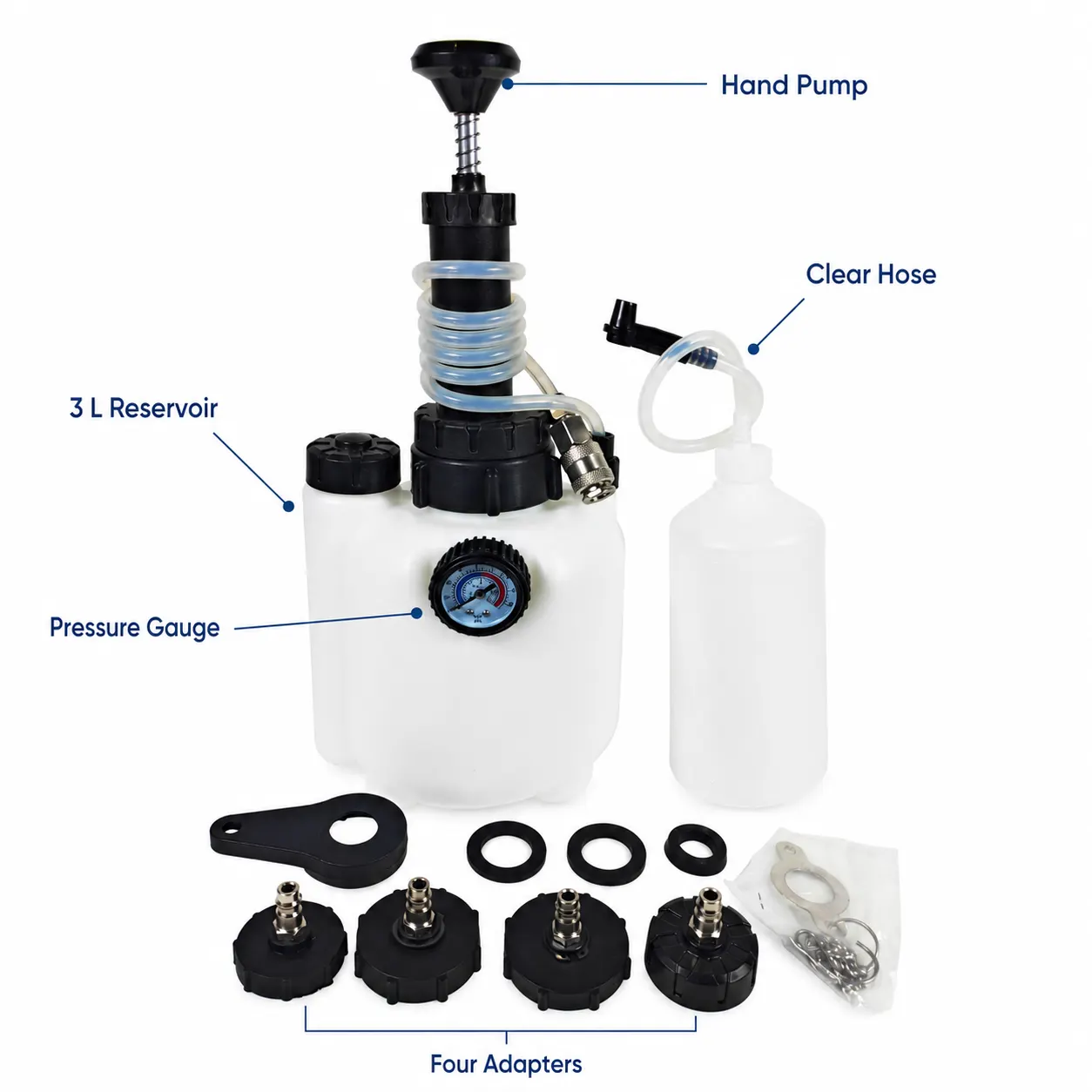
The product page states a locked 3 L reservoir configuration with four adapters. It presents the part for brake fluid replacement equipment and vehicle repair, while the archived offer states plastic construction.
Capacity helps identify what is being offered, but it does not prove that a 3 L reservoir suits a particular machine, workflow or vehicle. Manufacturer does not specify a pressure rating, scale accuracy, mounting arrangement, fluid specification or service life.
| Check | Why it matters | Published answer |
|---|---|---|
| Component role | Prevents buying a reservoir when a complete tool is needed | Reservoir with four adapters |
| Capacity | Must match the established equipment and process | 3 L |
| Interface | Controls whether the part can connect and seal | Manufacturer does not specify |
| Vehicle and fluid requirements | Controls the safe service decision | Manufacturer does not specify |
Compare it with the existing equipment
Before ordering, identify the reservoir connection on the equipment already in the workshop. Compare the old part's opening, outlet, seals, cap or locking arrangement with the current product information. The four-adapter count is not a substitute for a thread, seal or connector specification.
The listing does not name compatible machines or vehicles. If the connection cannot be established from the available documentation, treat fit as unconfirmed. That is especially important when a scheduled brake-fluid service depends on the equipment being ready.
- Write down the exact reservoir or accessory being replaced.
- Record the existing connection, seal and adapter arrangement before discarding the old part.
- Compare those details with the 3 L and four-adapter listing.
- Obtain confirmation before using the component when any interface detail remains unknown.
Keep vehicle safety separate from product fit
GOV.UK says drivers should check that the brakes work and use the vehicle handbook for maintenance information such as brake-fluid level. The Highway Code warns that low brake fluid may result in brake failure and a crash. These are reasons to keep the purchase and the vehicle-safety decision separate.
The Toolbrake page does not publish a vehicle-specific bleeding procedure, brake-fluid type, pressure limit or inspection result. Do not claim that installing this reservoir improves braking, completes a bleed or makes a vehicle safe to drive.
- Follow the vehicle handbook for the vehicle's fluid and maintenance requirements.
- Follow the equipment manufacturer's instructions for connection and operation.
- Use a competent inspection or repair route when the braking system's condition is uncertain.
Unknowns that should stop the order
A careful buyer should pause if the job depends on a named machine, a particular adapter thread, a seal material, a pressure rating or a brake-fluid compatibility statement. Manufacturer does not specify those details on the product page.
The documented value is narrower: a 3 L reservoir with four adapters for assessment against existing brake fluid replacement equipment. Treat it as a possible component replacement, not a universal brake-service answer.
Related guides and product details
Use the 3 L figure to shortlist the component, then verify the connection and vehicle procedure before allowing the part into a safety-critical job. Read Brake Fluid Replacement Machine Reservoir With Adapters for related guidance. Read 3L Brake Bleeder Reservoir Replacement: Checks Before Buying for related guidance. Review the documented specification on the 3 L Brake Fluid Replacement Reservoir with Four Adapters product page before ordering.
Sources and safety context
- Supports the stated capacity, four adapters, listed use and plastic construction. 3 L reservoir product page.
- Supports the use of the vehicle handbook and the need to check that brakes work. Check your vehicle is safe to drive.
- Supports the brake-fluid safety warning. The Highway Code: vehicle maintenance, safety and security.