
Short answer: A 3L brake bleeder reservoir replacement should be bought as a component match, not as a complete brake-service solution. The Toolbrake product page describes a locked 3 L reservoir configuration with four adapters, listed for brake fluid replacement equipment and vehicle repair, with plastic construction stated in the archived offer. It does not confirm a machine interface, vehicle coverage, pressure rating, brake-fluid compatibility, complete bleeding kit or safe procedure. GOV.UK warns that low brake fluid may result in brake failure, so any vehicle work must follow the vehicle and equipment manufacturers' instructions.
What is being replaced?
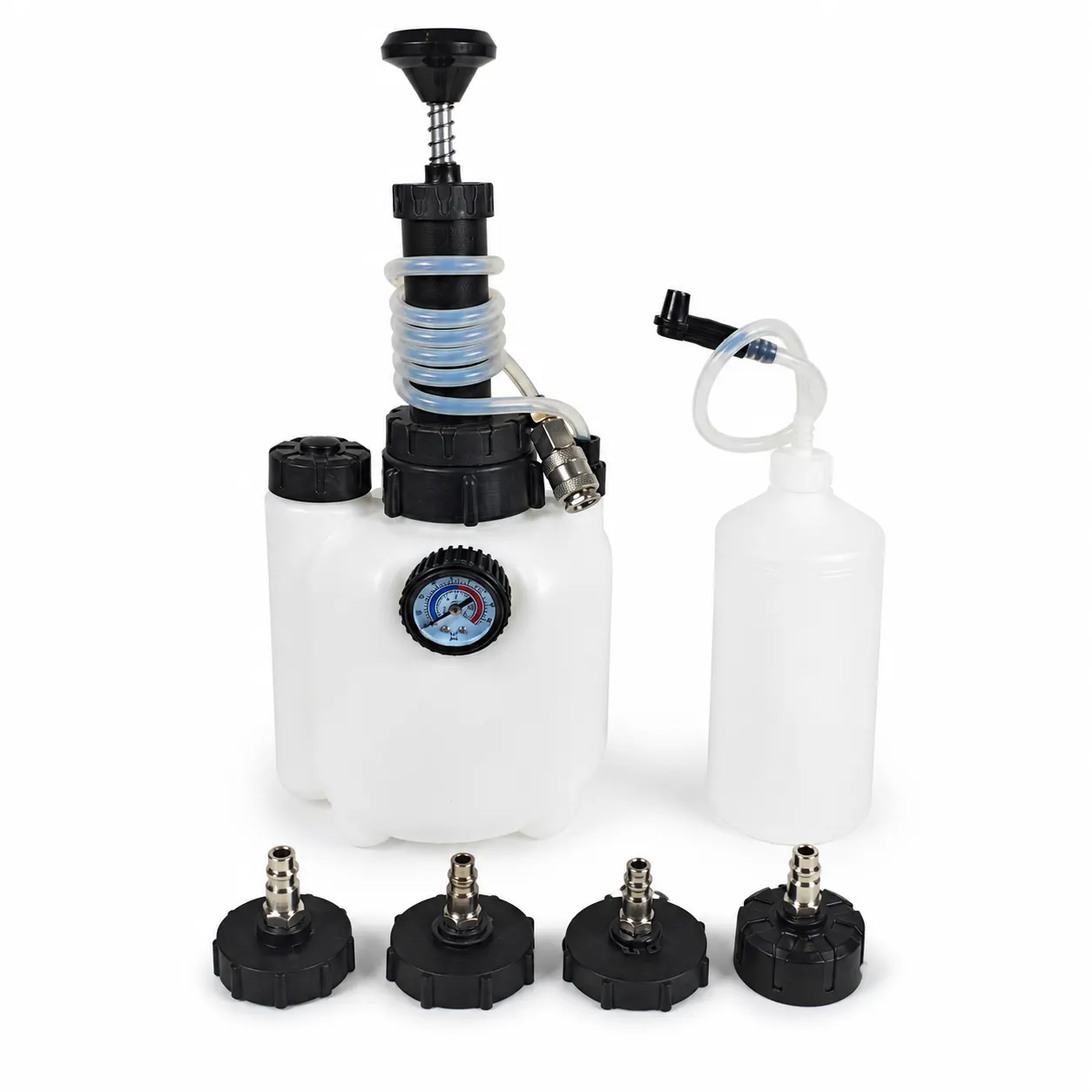
The Toolbrake page describes a locked 3 L reservoir configuration with four adapters. It lists the item for brake fluid replacement equipment and vehicle repair, and the archived offer states plastic construction.
Those facts identify the component category. They do not say that the part is a complete brake bleeder, pressure source, hose set, master-cylinder cap set or vehicle-specific kit. Manufacturer does not specify those broader claims.
| Published fact | Still needs confirmation |
|---|---|
| 3 L reservoir | Whether that capacity suits the existing equipment |
| Four adapters | Thread, seal, connector geometry and intended equipment |
| Plastic construction stated | Chemical resistance, pressure behaviour and service life |
| Listed for brake fluid replacement equipment | Compatibility with a named machine or vehicle |
Check the workshop interface first
Keep the old reservoir, current machine and existing adapters together while checking the replacement. Compare the reservoir opening, outlet, seals, hose or coupling and any locking arrangement using the live product information available at purchase. Four adapters describe quantity, not geometry.
The product page does not provide a confirmed vehicle list, machine list, thread specification, seal material, pressure rating or brake-fluid type. Manufacturer does not specify them. Do not turn the adapter count into a universal fitment claim.
- Confirm that the missing item is a reservoir rather than a hose, cap, pressure unit or complete kit.
- Compare the required capacity with the listed 3 L configuration.
- Identify the exact equipment-side connection and adapter required.
- Stop when the interface or fluid requirement cannot be verified from the available documentation.
Brake-safety boundaries
GOV.UK's vehicle-safety guidance says low brake fluid may result in brake failure and a crash, and the vehicle handbook should be used for maintenance information such as brake-fluid level. That makes the reservoir purchase a safety-related component decision, not a casual accessory choice.
The listing does not publish a bleeding sequence, vehicle-specific instruction, pressure limit or brake-fluid specification. Follow the vehicle handbook and the brake-equipment manufacturer's instructions. Do not drive a vehicle on the assumption that a reservoir replacement alone proves the braking system is safe.
- Use the vehicle handbook for the vehicle's maintenance and fluid requirements.
- Use the existing brake-service equipment instructions for the machine-side connection and procedure.
- Treat unresolved fit, leakage or fluid questions as reasons to stop and obtain competent advice.
Limits before you order
The Toolbrake page supports a narrow buying conclusion: this is a 3 L reservoir with four adapters associated with brake fluid replacement equipment. It does not support a claim of universal vehicle coverage, complete brake-bleeding capability, faster service, pressure performance or long service life.
If the job depends on a connector dimension, seal specification, brake-fluid type, pressure rating or chemical-resistance evidence, manufacturer does not specify it on the product page. Resolve that gap before purchase rather than relying on a photograph or the word adapters.
Related guides and product details
Buy only when the component role, 3 L capacity and equipment interface are confirmed; vehicle safety still depends on the correct procedure and inspection. Read 3 Litre Brake Fluid Replacement Reservoir: Workshop Fit Checks for related guidance. Read Brake Fluid Replacement Machine Reservoir With Adapters for related guidance. Review the documented specification on the 3 L Brake Fluid Replacement Reservoir with Four Adapters product page before ordering.
Sources and safety context
- Supports the reservoir, capacity, adapter count, listed use and plastic-construction statement. 3 L reservoir product page.
- Supports using the vehicle handbook for brake-fluid information and checking that brakes work. Check your vehicle is safe to drive.
- Supports the warning that low brake fluid may result in brake failure and a crash. The Highway Code: vehicle maintenance, safety and security.